

Artificial Intelligence in Tax Audits and Taxpayers’ Rights
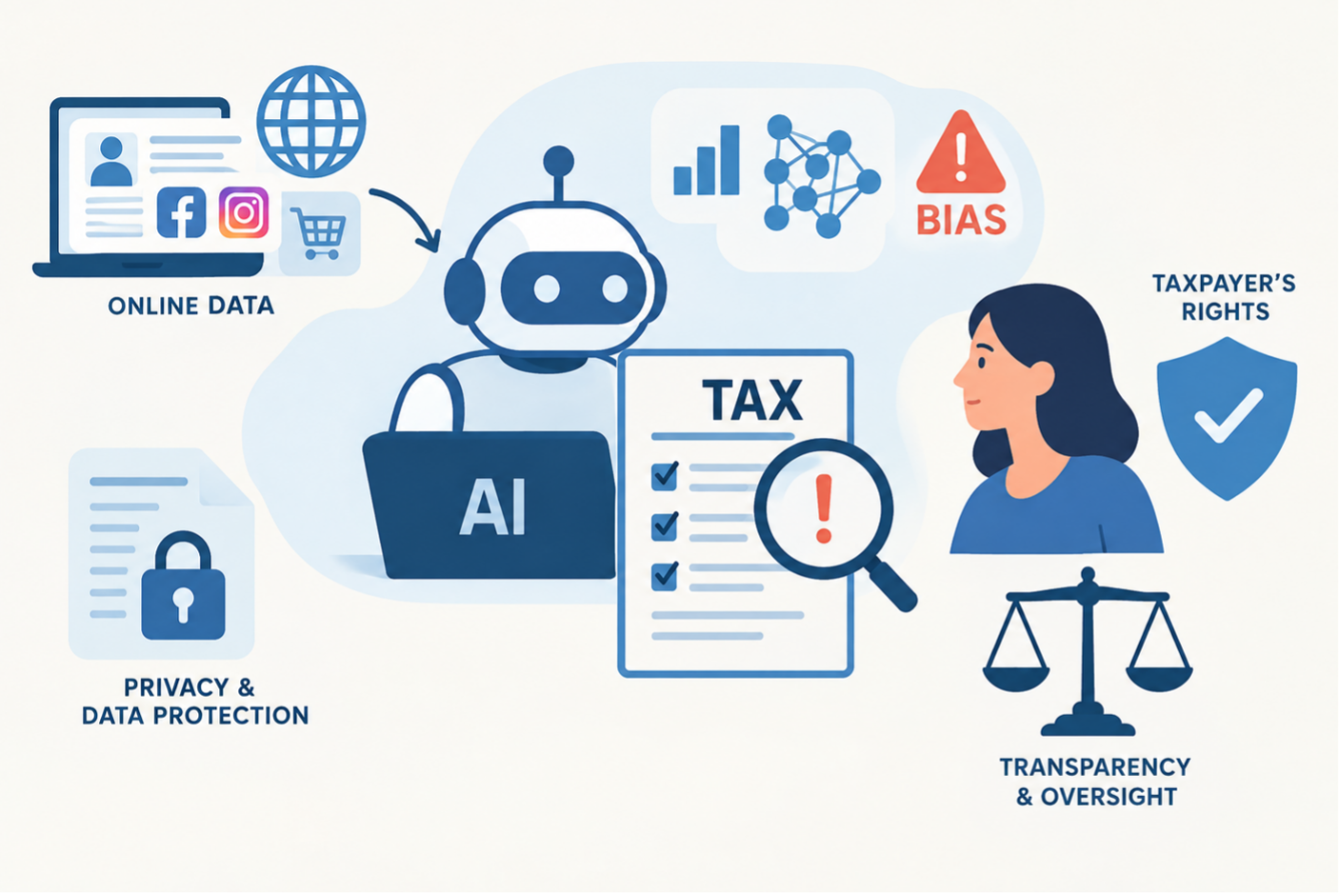
Unable to audit all taxpayers, tax administrations are constantly seeking effective methods of monitoring non-compliance and selecting taxpayers for audit. As an alternative to random audits, they have been testing annual selections of specific categories of taxpayers, parameters and statistics and, more recently, AI-based risk-management methods.
Some tax authorities collect and use taxpayers’ freely accessible content (e.g., on social media or online marketplaces) by means of “computerized and automated processing”. France offers an example of the use of “web scraping” for tax audit purposes. The National Commission on Informatics and Liberty and the Constitutional Council contributed to establishing a framework to protect privacy and freedom of expression: the tool can only collect data targeting deliberate breaches or fraudulent strategies that have led to an understatement or concealment of revenue; the information collected cannot alone form the basis for a recovery.
The use of machine learning in tax audit procedures raises an issue of legality. Statisticians and AI experts have warned about the trade-off between prediction accuracy and model interpretability. Decision trees are easy to interpret, since each step can be described with an "if-then" rule, but they are not competitive with the best supervised learning approaches in terms of accuracy. Neural networks, especially when deep learning is involved, tend to learn black boxes: it is not possible to identify a rule linking the output to the input. The lack of transparency hampers the ability of public officials to exercise substantial oversight and the ability of the recipient of the decision to understand its rationale. One may wonder whether these findings are interpretable enough for taxpayers to accept error correction and for tax officials to conduct a deeper audit without fear of contradicting AI. Without sufficient human oversight, the duty to state reasons and, ultimately, the taxpayer’s right to defense may be undermined.
When it comes to fairness, AI is often endorsed for its neutrality, because it seems able to circumvent human bias. However, it can lead to discrimination based on biased data or training, with a potentially massive reach when compared to human bias. Machine learning identifies correlations, not causal relationships, and sometimes correlations may be random or based on irrelevant characteristics. Unsupervised techniques avoid biased results due to biased training, as there is no supervisor involved, but do not prevent biased results due to biased data, while decision trees are highly exposed to biases. The ability of AI to make decisions in an instant can amplify the impact of biased data and training, leading to thousands of incorrect decisions.
This was the case in the Netherlands, where the government resigned in 2021 over the childcare allowance scandal. According to a parliamentary inquiry, the algorithmic system wrongly classified foreign parents as ineligible recipients, presumably because it was trained on previous assessments of fraud involving foreign individuals. As Dutch nationality was not required to receive the allowance, this characteristic should have been excluded from the training data. Instead, thousands of erroneous recovery orders were issued, causing financial and personal hardship, due to poor training of the risk-management system and minimal human oversight. Similar concerns are apparent in the US, where recent studies show that, despite the overall decline of tax audits due to budget cuts, low-income taxpayers, who often come from counties where most of the population is non-white, are far more likely to be audited. The IRS regional bias reveals a class bias that is not intentional and is most likely due to the low cost of auditing the earned income tax credit. As self-learning algorithms learn from the past, AI-driven selection of taxpayers for audit can only worsen these outcomes, perpetuating historical patterns of discrimination.
Not even the EU AI Act appear to address these issues. It acknowledges the risk of discrimination for credit scoring, since it may perpetuate historical patterns of discrimination, and imposes on high-risk systems requirements of high quality data, transparency, human oversight, accuracy and robustness. Yet systems intended to be used for administrative proceedings by tax and customs authorities are not classified as high-risk. The underlying assumption seems to be that the rights at stake in tax procedures are less significant, which is not always the case: the income tax system is also used to provide social benefits and redistribute wealth, and taxpayers who depend on those benefits or are in a vulnerable position should not be excluded from this protection.
According to case law in different European countries, three main rights should be granted when public administrations rely on automated decision-making tools: the right to algorithmic transparency, the right to human intervention and the right to protection against discrimination. These rights are mainly inferred from the right to private life enshrined in the European convention on human rights and in the EU Charter of fundamental rights, and are further developed in the GDPR, which grants the right to be informed about the existence of automated decision making, including profiling, and the right not to be subject to a decision based solely on these techniques. However, the GDPR allows member States to restrict those rights to ensure objectives of general public interest, including taxation matters. The principle of tax secrecy, preventing reverse engineering of tax audits, is difficult to reconcile with algorithmic transparency. While such a limitation is reasonable, other restrictions should be avoided or reconsidered, such as limitations to the rights to access and rectify personal data held by tax authorities and to the right to refuse fully automated fiscal decisions.
Under the obligation to state reasons, tax audit notices resulting from automated decision-making techniques should only be upheld if the reasoning is interpretable and coherent with the relevant tax provisions. Taxpayers should always be granted the right to be heard. The ability of self-learning algorithms to extract knowledge from data can also suggest new assumptions, whose rationale deserves careful evaluation before accepting them for tax assessment purposes. An acceptable level of protection could be negotiated as part of the amendments to the EU AI Act, or pursued through amendments to the existing Taxpayer Bills of Rights or through the approval of Digital Government Taxpayer’s Charters.
(Focus by Chiara Francioso)
Selected bibliography:
ABREU, Racial issues in tax law: identification, redress, and a new vision of horizontal equity, in PARADA (Ed.), A Research Agenda for Tax Law, Cheltenham-Northampton, Elgar, 2022, 110
AMNESTY INTERNATIONAL, Xenophobic Machines. Discrimination Through Unregulated Use of Algorithms in the Dutch Childcare Benefits Scandal, London, Amnesty International Ltd, 2021, 26.
BLOOMQUIST, Regional Bias in IRS Audit Selection, in Tax Notes, March 4, 2019.
CONTRINO, Digitalizzazione dell’amministrazione finanziaria e attuazione del rapporto tributario: questioni aperte e ipotesi di lavoro nella prospettiva dei princìpi generali, in Riv. dir. trib., 2023, I, 124.
DE LA FERIA-GRAU RUIZ, The Robotisation of Tax Administration, in GRAU RUIZ (ed.), Interactive Robotics: Legal, Ethical, Social and Economic Aspects, Cham, Springer, 2022, § III.
FASOLA, L’amministrazione algoritmica dei tributi, Giuffrè, Milano, 20253, 84 et seq.
FRANCIOSO, Automated decision making by tax authorities and the protection of taxpayers’ rights in a comparative perspective, PEDRINI (Ed.), Law in the Age of Digitalization, Aranzadi, Madrid, 2024, 221.
GUIDARA, Accertamento dei tributi e intelligenza artificiale: prime riflessioni per una visione di sistema, in Dir. prat. trib., 2023, 414.
HADWICK-LAN, Lessons to Be Learned from the Dutch Childcare Allowance Scandal: a Comparative Review of Algorithmic Governance by Tax Administrations in the Netherlands, France and Germany, in World Tax J., 2021, 609 et seq.
HOFFMAN-BLOOMQUIST, A Closer Look At IRS Tax Audit Selection Bias, in Forbes, January 19, 2021.
JAMES et al., An Introduction to Statistical Learning, Springer, New York-Heidelberg-Dordrecht-London, 2013, 24.
KUŹNIACKI et al., Towards eXplainable Artificial Intelligence (XAI) in Tax Law: The Need for a Minimum Legal Standard, in World Tax J., 2022, 573.
MONTANARI-GIORGI, Digital Government Taxpayer’s Charter, in ANTÓN ANTÓN-GARCÍA HERRERA BLANCO (Eds.), Digital transformation of tax administrations in the European Union, IEF, Madrid, 2023, 279.
PAPARELLA, Brevi note sulla recente disciplina in materia di intelligenza artificiale nella prospettiva dell’attuazione del tributo, in Riv. tel. dir. trib., September 22, 2026.
PONTILLO, Algoritmi fiscali tra efficienza e discriminazione, in Riv. trim. dir. trib., 2023, 649.
RAGUCCI, L’analisi del rischio di evasione in base ai dati dell’archivio dei rapporti con gli intermediari finanziari: prove generali dell’accertamento "algoritmico"?, in Riv. tel. dir. trib., September 4, 2019.
SARTORI, I limiti probatori nel processo tributario, Giappichelli, Torino, 2023, 74.
TRESCHER, France’s approach to artificial intelligence by the French tax system, Studi Tributari Europei, 2024, I.5.